Bhubaneswar, January 23: The East Coast Railway (ECoR) has achieved a historic milestone by recording its fastest-ever Rs 23,000 crore originating freight earnings, reinforcing its position as one of the top-performing zones of Indian Railways in freight operations.
The ECoR reached this landmark in a record 294 days during the current financial year 2025–26, i.e., on 19 January 2026, which is 27 days earlier than the previous financial year 2024–25, when the same milestone was achieved in 321 days. This remarkable performance reflects the sustained growth trajectory and operational efficiency of the zone.
Originating Earnings Performance (Up to December 2025)
The East Coast Railway’s total originating earnings increased from Rs 21,543 crore in 2024–25 to Rs 23,959 crore in 2025–26, registering an overall growth of 11.21%.
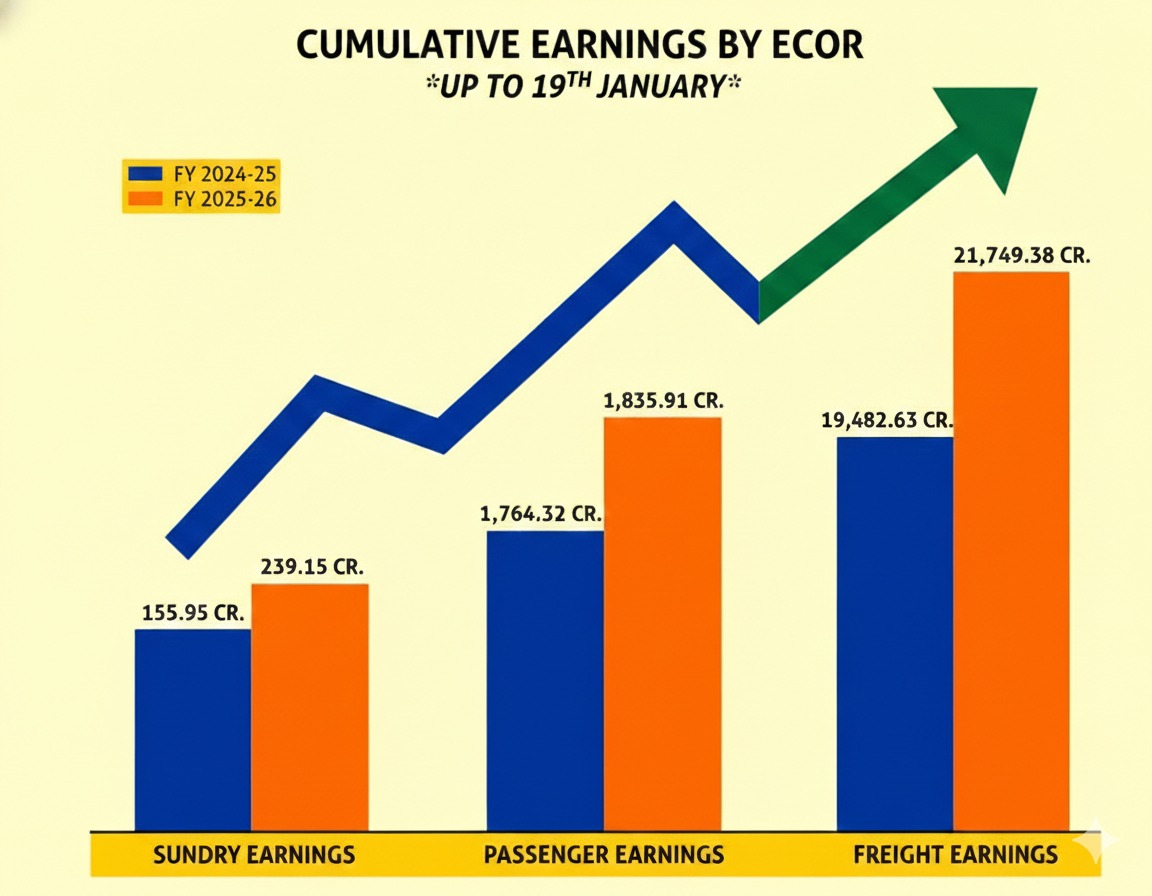
• Passenger earnings rose from Rs 1,764.32 crore in 2024–25 to Rs 1,835.91 crore in 2025–26.
• Goods (freight) earnings witnessed a significant jump from Rs 19,482.63 crore to Rs 21,749.38 crore, underlining the zone’s strong freight base.
• Sundry earnings increased substantially from Rs 155.95 crore to Rs 239.15 crore, indicating diversification and improved ancillary revenue streams.
This consistent growth across all segments highlights East Coast Railway’s vital contribution to Indian Railways’ overall revenue generation.
Freight Loading Performance (Up to December 2025)
The East Coast Railway has also delivered an outstanding performance in freight loading and has emerged as the Number One Zone in Indian Railways up to December 2025.
• The freight loading achieved up to December 2025 was 209.97 Million Tonnes (MT).
• Compared to the previous year’s loading of 188.64 MT, the zone registered an absolute increase of 21.33 MT.
• The year-on-year percentage growth over the previous year stands at 11.31%.
This outstanding performance underscores East Coast Railway’s pivotal role in strengthening the nation’s freight economy and supporting industrial growth in its hinterland. Continuous monitoring, innovative operational practices, and the dedicated efforts of railway employees have played a key role in achieving this milestone well ahead of schedule.