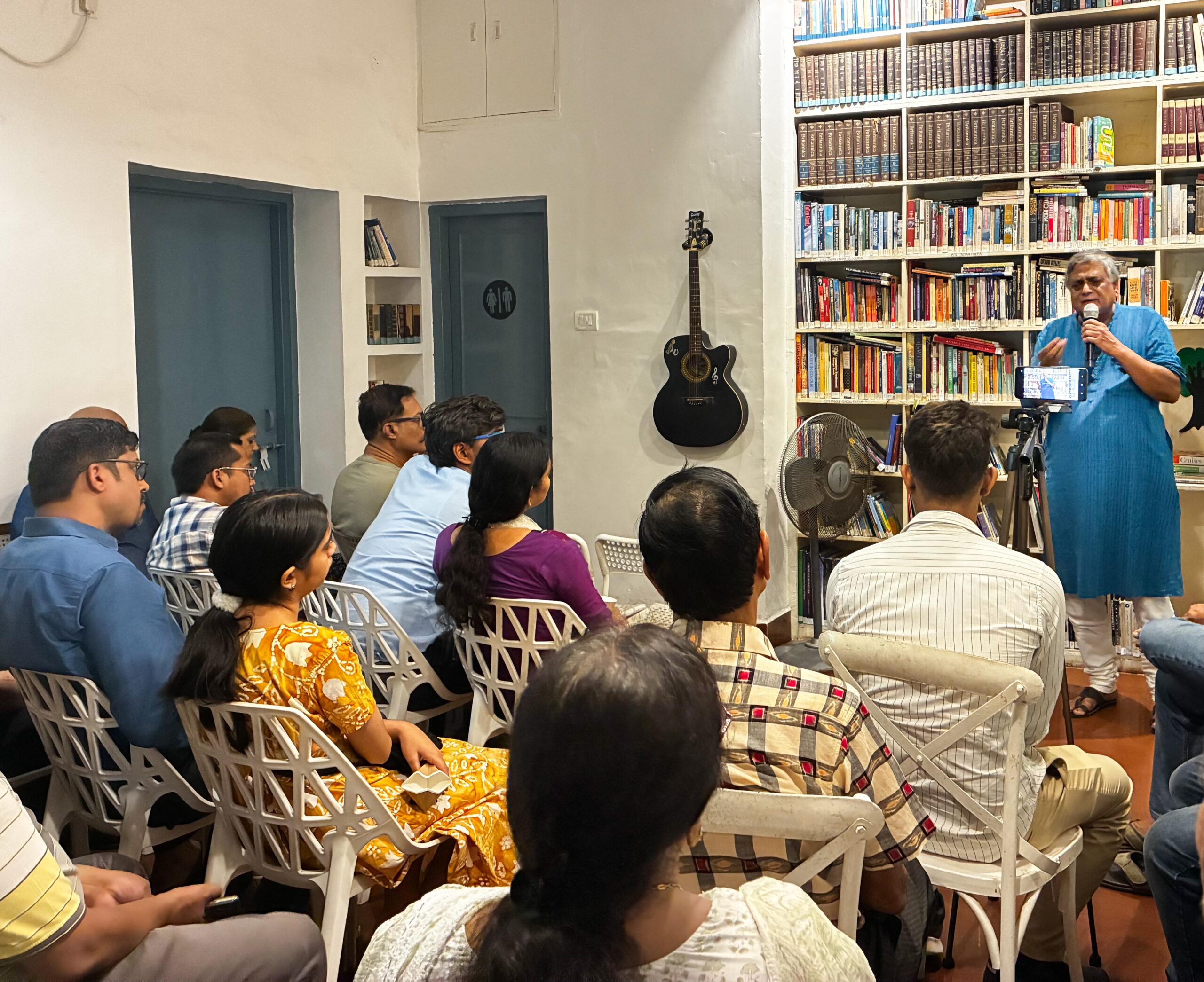
Bhubaneswar, May 31: The significant contribution of the Punjabi community to the making of Bhubaneswar was highlighted in a talk by noted researcher and heritage enthusiast, Anil Dhir at Café 16, Satyanagar, as part of the “Ekamra Talkies” series jointly organized by Bakul Foundation and Café 16.
Welcoming the audience, Bakul Foundation founder Sujit Mahapatra spoke about the objective of Ekamra Talkies, launched in 2024 to document and celebrate the memories, stories and lived experiences of Bhubaneswar’s residents during the formative decades of the 78-year-old capital city. He recalled earlier talks in the series, including Deboo Patnaik’s presentation on the history of eating out in the city and Anant Mahapatra’s recollections of Bhubaneswar in the 1940s, 1950s and 1960s.
The gathering began with a minute’s silence in memory of Ashok Mohanty, who had delivered a talk on the history of sports in Bhubaneswar as part of the series and passed away recently. Deboo Patnaik briefly reflected on Mohanty’s contribution to preserving the city’s sporting history and the loss of a valuable repository of memories with his passing.
In his presentation, Dhir explained how the construction of Bhubaneswar as a new capital city in post-Independence India created opportunities for skilled professionals and entrepreneurs from across the country. He noted that many Punjabis, particularly Partition refugees with experience in railway construction and large-scale building projects, came to Bhubaneswar to participate in the city’s development. According to him, several major public buildings, including the Secretariat and the Assembly, were built under the leadership of Punjabi contractors.
Dhir also shared personal memories of growing up in the Punjabi Colony of Satyanagar, the only neighbourhood in Bhubaneswar that developed around a specific community. His father, who moved to Bhubaneswar when Dhir was just a year old, played a pioneering role in encouraging Punjabi families to settle in the city. At its peak, the colony was home to around forty Punjabi families.
He described the early years of the colony, when the area adjacent to the railways tracks was sparsely populated and bordered by wilderness. Wildlife sightings, including jackals and even the occasional tiger, was not uncommon. Recalling the challenges of life in those days, he painted a vivid picture of a rapidly developing city that still retained many features of its natural landscape.
Dhir also reflected on how many Punjabi families eventually left Bhubaneswar following the anti-Sikh riots of 1984, when concerns about safety and uncertainty prompted them to relocate elsewhere.
The event was attended by members of the Punjabi community whose families had been part of Bhubaneswar’s early history, including Hardaman Singh, whose family migrated from Rawalpindi. Also present were eminent citizens such as Deboo Patnaik, Ashok Bal, former Chief Commissioner of Income Tax and Lalitendu Dasmohapatra, former Director General of the National Archives of India as well as young college students.
The talk generated lively discussion and offered valuable insights into a lesser-known chapter of Bhubaneswar’s history, highlighting the role played by migrant communities in shaping the city during its formative years.